Monday, June 18, 2012

Is Resentment of Privilege Inevitable?

Where the Rubber
Hits the Road
Now that our society seems to have fully incorporated the one percent/ninety-nine percent concept into our socioeconomic discourse, right-wing conservatives are busy impugning that all this negative attention the one percent are receiving is simply the jealousy and resentment of the "deservedly" unsuccessful, or less successful, underclass.

With all their money behind them, they are getting some traction with this approach. As for myself, in my sixth decade, I am trying to make peace with my life decisions, opportunities and lack thereof. Lately I've been thinking a lot about whether or not my political positions are motivated by these types of unsavory and destructive emotions.

Just this past Friday, my partner and I went to see a couple of films at the San Francisco LGBT Film Festival that were on the subject of specific lesbians of our generation who achieved recognition in progressive politics. One film was about Charlotte Bunch who started out in the seventies as a lesbian feminist activist and wound up a career academic (without advanced degrees) who worked with international organizations advancing women's rights in mostly third world settings.

The second film was about Ellen Ratner, someone whose work I was not familiar with. She is a liberal radio broadcaster (she claims the only one) for the rabidly conservative Fox network. Ratner is my age and actually attended the same junior high and high school that I did although I never spoke with her. She inhabited a wealthy world that did not intersect with mine in any way (neighborhood, friendship circles, activities, interests).

This documentary, "Ellen Ratner: "A Force of Nature," was produced by Barbara Kopple filmmaker of "Harlan County, USA," the award-winning chronicle of a coal miners' strike in a rural Appalachian town. Clearly, this film was a challenge for Koppel. Unlike the Kentucky coal miners, Ratner is an heiress from a real estate dynasty. (this information is from other research, it is not in the film). I understand that in these times particularly, depicting an eccentric, essentially kind-hearted, but massively privileged, liberal who made good is not easy. None of her homes or living arrangements were shown. The segment of Ratner, a boss in her workplace, trying to get a black woman underling to say she liked Ellen as a person, made me cringe. But more safely, Koppel filmed Ratner almost exclusively on a philanthropic mission in Africa. The only outright allusion to the wealth of her family was the fact that she bought her wife, a former Air Force pilot, her own airplane as a gift. It was a sweet gesture but certainly not one that many other folks could duplicate.

So am I resentful of people, even those who are speaking up for lesbian rights, who have benefitted from so much more opportunity and privilege? And, if I am, is that wrong? I am aware that when I am feeling good about myself and my life, my negative feelings toward others disappear. As a nominal Buddhist, I know not only that those feelings are counterproductive, but also that having access to money and things doesn't necessarily make a person happy. On the other hand,  not having any access, i.e.: living on the street and starving, can truly make a person miserable. To some degree, I also believe, even though this sounds really corny, that experiencing struggle tends to build character and resourcefulness.

I do often wonder who I would have been and what I could have done if I'd come from a background where financial stress did not play such a starring role. But truly, that's as hard to imagine as who I'd be if I'd been born African-American, straight or even gentile. I'm not sure of what that person would have been like, only that she (or he) would have been someone else.

So, do I covet Ellen Ratner's cushy life and experience? Absolutely not! Do I resent people who have had access to more power, privilege and opportunity? Well, not in theory, but my honest final answer would have to be that it depends on which moment you ask me.

Wednesday, June 13, 2012

Friend Selection: Do I Know Too Many Jews?

Birds of a Feather?
I have been thinking a lot lately about the process of selecting friends. I don't know if I'm good at it, I think for the large part, I let them select me. Still, when I view them as a group there are some common themes. Yes, I do know a lot of Jews, tons of childless people, a good number of queers and an overwhelming amount of civil-service workers. Throw in a handful of starving artists as well. Almost all of my friends seem to be from lower middle class or working class families, who have backgrounds somewhat similar to mine.

Obviously, I never set out with a set of guidelines for friends, the results just evolved. It all seems random like it just happened. Friendship, like lovership is surrounded by an aura, a mystique. But clearly, the people we gather around us are folks we are drawn to for a myriad of reasons.

The Jewish dynamic can be a bit unsettling. I grew up in a neighborhood near Cleveland that was about 85% Jewish. This did not evolve through cliquishness, but was a natural consequence of "gentleman's agreements" that limited the places Jews were permitted to live. I despised the insular nature of this singular, ethnic community and couldn't wait for the time when I would try my luck in the, reputedly quite Anti-Semitic world. So why, in adulthood, do I return to my roots so often in the friendship realm?

The Jews who made up my world left deep marks on my psyche. Not just because of history and sad tales of persecution but due to cultural styles, modes of expression, ways of looking at life and both interpreting and expressing it to others. In later life, I was forced to come to the conclusion that, in spite of my best efforts, I am a terminal Jew. People of all ethnicities who appreciate my humor, my observations, my glass half-empty perspective gravitate towards me. Those who find it annoying, overly analytical or too negative head for the door.

Oppression has a language all its own. It's not a upbeat idiom but we learn it by heart when we are young.The more oppressed people are the thornier and more difficult they tend to be. Not because they are inherently inferior, but because they are more damaged. I don't think this is, in and of itself, a bad thing. Would you choose to eat bland food at every meal? Many Americans do.

The upside to a heritage of oppression is that we need each other more. This explanation applies to differences in gender orientation and socioeconomic class as well. The class thing is especially difficult to sort out. I tend to experience more working class people as more open, less what we used to call, snotty. When I worked at the San Francisco Water Department I would get into conversations about everything from laundry detergent to unrequited love.The topics were not necessarily deeply introspective but there was a free-flowing exchange of information that was not coated with suspicion and trepidation.

At the Main Library, people with master's degrees were circumspect. You were expected to keep your mouth shut and climb, baby, climb. In the striving class, to expose yourself is to give weapons to the potential enemy. The "appropriate" subjects of conversation are based upon work. Unless you found someone you could really trust you did not talk about real life experience. I found the walls that co-workers intentionally placed between one another jarring and upsetting. I was never acceptable in the upper middle-class world that I had worked so diligently to enter. My role was that of the square peg being relentlessly hammered into a round hole. Fortunately for me, those corners never got shaved off or worn down. I must be made of harder material than I'd previously imagined!

Wednesday, June 6, 2012

The World on Tuesdays

Things happen every day in the world that working people know nothing about. For example, now that I have been retired a couple of weeks I've discovered that my town, Berkeley, has a big farmer's market on Tuesday afternoons. Seventeen years of missed Tuesdays, can I really account for that? Clearly, many folks fill cafes and stores every week day. They must be either unemployed or work odd hours.

Tuesdays are full of other wonders as well. Elections invariably take place on them. Yesterday was an example of this phenomenon. The despicable Scott Walker won out easily over the recall efforts thereby demonstrating the devastating impact of Citizens United and just what money can purchase in our increasingly no-holds barred plutocratic society. The corporations and the 1% outspent the now-decimated unions and progressive groups seven to one. The senate Republicans also managed to block the Paycheck Fairness Act a followup bill to the Lily Ledbetter legislation that would mandate equal pay for women.

It's hard to know what will come next. The repression against the 99% has been largely successful. There seems to be only a small percentage of Americans who are capable of independent thought. The splintering of the various subgroups and caucuses is evident to those of us who are still active. Old prejudices keep rearing their ugly heads. I have every intention to keep on keepin' on but, as you can probably deduce, I am quite depressed at this juncture.


On another subject,  retirement is solidifying as a reality for me now. Sunday, the Emu, better known as my somewhat domesticated partner Deborah, threw me a retirement party with fabulous cuisine and even more fabulous friends. Thirty-two people of all genders and orientations filled the tiny cottage and yard. The one thing they all have in common is that they live large, not in the sense of consuming material goods, but in the sense that they all have hearts and minds that stretch far beyond the limits of a circumscribed life that revolves around the nuclear family. The second thing they all had in common was that they are my friends, a simple fact that makes me eternally grateful. I want to thank all of them for their warm wishes and support!


Wednesday, May 30, 2012

The War on Queers

More and more crazy pastors, ministers, even Louis Farrakhan are no longer satisfied with simple ostracism and condemnation of LGBTs and are now advocating internment in concentration camps and even the death penalty for non-gender conforming people in the USA. Like the war on women, the war on queers has been, of late, consumed with renewed vehemence and vigor. So much so that even prominent progressive theorists like Chris Hedges, are writing about that war.

It is a relatively new and welcome development to have heterosexuals write seriously about the Queer Struggle. One that signifies we are finally making it into the main stream of civil rights ideology. Bullying, suicide, gay parenting issues and all kinds of job discrimination cases are more in the news spotlight than ever before. They are not happening more often than before but are now receiving more critical attention.

Obama's "evolution" on same-sex marriage is part of the reason for both the push for civil rights and the backlash against it. But the biggest reason for this outbreak of culture war vituperation is the same one we saw in Germany in the thirties. The tanking economy along with rising prices (food, gas, sales tax) is a pressure-cooker for hatred of all sorts. When folks in desperation turn to their twisted notion God, he tends to tell them lies about who the real enemy is. The more "Christian" our country becomes, the more fear and hate its citizens seem to want to perpetrate.

As harassment of LGBT folks in small town and rural USA becomes more open and explicit, ordinary life becomes more difficult. Yes, there are places like New York City and San Francisco and other urban centers where things are relatively unchanged. As Reverend Otis Moss III does quite eloquently in this sermon, it is imperative that we expose and fight against what is happening to our people and get the word out that non-gender conforming and gay people are neither the enemy nor the ones who have brought our country to the brink of financial ruin.

Friday, May 25, 2012

Dehumanization in the Capitalist Workplace


Along with the relatively recent rebirth of a movement against economic injustice has come not only questioning not only of the great wealth divide but also the structure of the capitalist workplace itself. As jobs disappear many are re-examining the hierarchy of the American labor force and formulating ways to make it more just and humane.

Marxist economist Richard Wolff points out that financial transactions don’t work within the family unit because they promote greed and discord, so why would anyone expect these same skewed priorities to function any differently in the workplace?

Capitalism requires all workplace interactions at work to have, at their foundation, the profit motive that requires the maximum accumulation of capital is the goal of any endeavor. In a service industry such as a hospital, library or school, this goal translates to servicing the greatest number of people with the lowest amount of expenditure. This is effected by a work speed up requiring more desk hours, patients and ever-increasing class sizes. In order to enforce this speed-up, the pressure is applied to middle management.

This group consists of folks who are offered extra goodies in exchange for extracting the maximum amount of monetary value from the effort of each worker, like squeezing as much juice as possible from an orange. There are always people willing to control others in return for their own personal comfort but no matter how you slice it, this process is inherently unpleasant. 

In the workplace it is commonly accomplished in one of two ways: manipulation or intimidation. Most often, it winds up being a combination of both. Manipulation includes not only the concept of worker discipline, but the more pleasant aspects of a worker/manager relationship as well. For example, praise for work is included here. While, in some cases, this may be genuine, it also serves the function of motivating the worker to continue to work hard. Intimidation is the method that is more fundamental to the manager/worker relationship. Every interaction at work harbors veiled threats to the survival of the worker because, at any moment, his position could be terminated. In the private sector, where the“employment at will” doctrine prevails, job insecurity creates perpetual stress. It is only with the advent of union protection that working people were granted a bit of relief from this sword of Damocles. 

In an inauthentic, contrived, highly-pressurized environment like the capitalist workplace, collateral damage is everywhere. In public sector work, managers are trained to distance themselves from treating and even perceiving their subordinates as human beings. Training workshops are instituted to instruct them not to engage their underlings in genuine conversations about the actual concerns in their lives. Any opening that might let friendship in must be slammed shut. This would interfere with the credo of putting production first and foremost. A philosophy where suppressing anything close to emotional intimacy is an absolute necessity.

For starters, we can begin rethinking and reworking ideas that have ceased to function properly and replace them with a more beneficial and productive vision. We all deserve something better. How can we create a cooperative workplace? Is there a way to pay people for creative contributions to society, not just wage slavery? A cooperative model would be a good starting point. Those who have a say in their lives at work will be more likely to pull together for a common goal. In a world where everyone can earn compensation for some kind of contribution, there would be no need for every exchange to be predatory or adversarial.

Alliances are stronger than hierarchies. Subordination only breeds varying degrees of resentment.. We are all tired of the tired old degrading capitalist model that is now longer functioning. Instead of begging for a piece of the pie, now is the time to throw out the moldy mess and begin to bake something entirely new.

Monday, May 21, 2012

Sexism Must Die!

It's undeniable that the Republicans are waging war against women. But just how are women faring in other political communities, for example that of the 99%? Has sexism been defeated in the sixty plus years since the emergence of second-wave feminism, dated roughly from the popularization of Simone De Beauvoir's book, "The Second Sex," first published in 1949, but translated into English and read widely for the first time in the fifties.

I wish I could report back that the Occupy Movement is free of sexist bias, but honestly, I can't. It is undeniable that many young women, as well as young gender non-specific types, are stepping up with competence and assuming power, but an alarming crisis of self-esteem and bias still persists in the meetings I have attended. Women are still hesitant to speak up and will undercut their statements with phrases like,"I don't know that much about this but..." There is often a preponderance of males in meetings and when it comes to stepping up to summarize goals and lead groups, men still dominate the proceedings.

A Workers Assembly meeting I attended this weekend was about two thirds male to one third female in composition. This probably occurred because union membership is skewed to favor higher paid, better jobs, which are primarily held by males. This is not to imply that women are silent at these gatherings. Women my age (fifties and sixties), for the most part, don't seem to have problems speaking out. Some younger women are taking leadership as well. But more pervasive overall patterns of discrimination and even self-suppression are apparent and more difficult to erase.

Last night I attended a second small meeting of an Occupy spin off that was a small group of boomer males with only a couple of women. A very articulate woman took notes at the last meeting and she was drafted again, somewhat against her will, as note-taker at this one. Of course, that was after all the males refused to volunteer and their gazes turned toward me. I replied, just as the men had, that I didn't have a laptop or know stenography either! I didn't address the gender bias because I was caught off-guard. I thought we dealt with this in the sixties when we women walked out of the Students for a Democratic Society (SDS) because we didn't want to be secretaries and coffee fetchers.

I guess the more things change, the more they stay the same. The fact of the matter remains; this prejudiced behavior is unacceptable and it will only serve to undermine our movement. At this point I'm trying to pull together a presentation of sexism and homophobia that both young and old can understand. The very lifeblood of our movement depends upon it!

Tuesday, May 15, 2012

State by State Civil Rights?

Women Worked Long and Hard
Yes, I am glad that our frightened, ultra-cautious, politically pandering president gave a grudging nod to same-sex marriage after a swift one to the behind by butt-kicker, Joe Biden. But I am not happy with the sentence he used to qualify his decision, the one relating to Sasha and Malia friends who have very nice, acceptable queer parents. Civil rights should not be dependent on niceness or acceptability. Even the craziest and nastiest minority members deserve to be treated as human beings.

Same-sex marriage rights, or other civil rights for minorities have and will continue to lose when put up for a vote by the majority. The pitches for these votes repeatedly call upon representing "the will of the people." But exactly who are the people? I have always been deluded into believing that I am one of them.

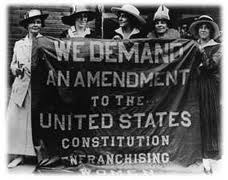
Women did not win suffrage by a majority vote. It was through prolonged political struggle. Not until 1920 did the Nineteenth Amendment to the Constitution pass giving over one half of the population the right to determine their own destinies through the ballot box. The first stirrings of that movement occurred as far back as the 1820's, one-hundred years earlier.

So many of us will not live to see victory for LGBT civil rights. By victory, I mean full federal constitutional protections on every level, from health care, to job discrimination, to immigration, inheritance, tax law, everything that heterosexuals take for granted. These rights extend far beyond the simple concept of marriage. They are the building blocks that could help create a foundation of a fair and equal society, at least on paper.